
How are primary and secondary forms of dementia differentiated?

Alzheimer's disease
Alzheimer's disease is one of the primary forms of dementia
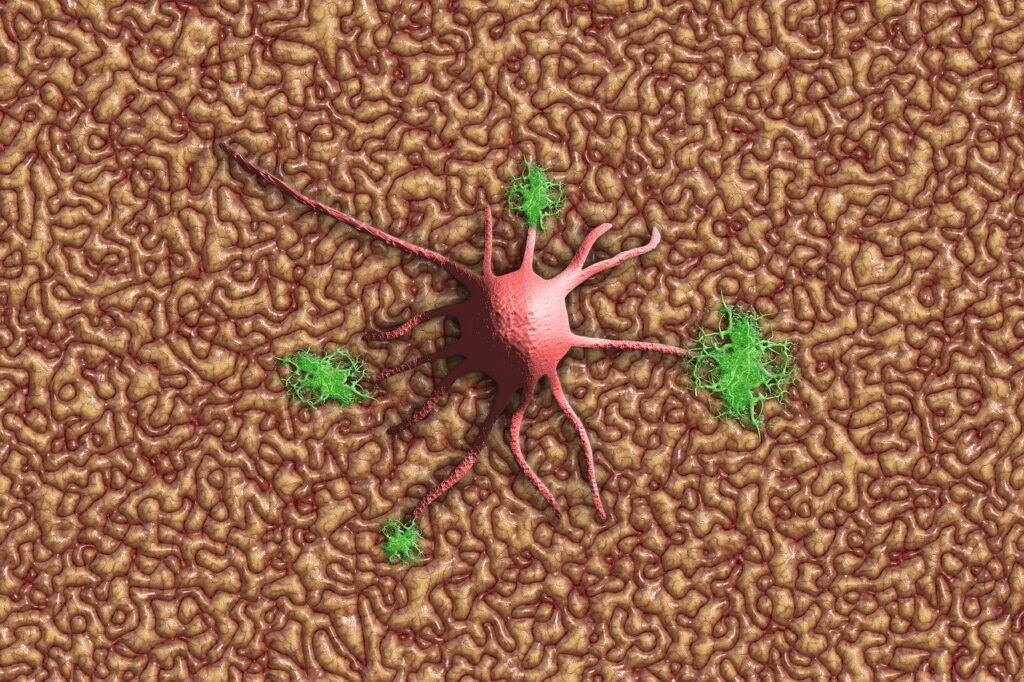
Picture: geralt (Pixabay)
(Textbook Health and Nursing Assistance, 2019, ed. Sens-Dobritzsch, page 553)
Who was Alzheimer's again?
Alois Alzheimer was a German neurologist and psychiatrist who is best known for discovering and describing Alzheimer's disease, which was named after him.
In 1901, Alzheimer treated a patient named Auguste Deter, who suffered from memory loss, orientation problems, speech disorders and unpredictable behaviour.
After her death in 1906, Alzheimer examined her brain and discovered conspicuous changes, including amyloid plaques (protein fragments that clump together) and neurofibrillary tangles (pathological bundles of tau proteins) He described these pathological features in a lecture at a medical congress in Tübingen, which led to the recognition of Alzheimer's disease.
(Alzheimer, Diagnose Verlauf Behandlung, 2017, ed. VKI Müller, Dal-Bianco, page 35-40)

Picture: Mohamed_hassan (Pixabay)
Auguste D. said about herself and her illness when she was in a good self-reflective moment: "I sort of lost myself"
(Alzheimer, Diagnose Verlauf Behandlung, 2017, ed. VKI Müller, Dal-Bianco, page 35)
Lewy body dementia
The primary forms of dementia include Alzheimer's disease and Lewy body dementia
It is very similar to Alzheimer's disease and is a possible cause in around 10 per cent of cases.
Lewy bodies can be detected in the nerve cells of the cerebral cortex.
Lewy bodies are round inclusions in the cell fluid of nerve cells that consist of abnormal proteins. These abnormal proteins cause the functional disorders in information processing.
Frontotemporal dementia
Frontotemporal dementia is also one of the primary forms of dementia
Frontotemporal dementia is a disease of the frontal brain and can also occur at an earlier age.
The breakdown of nerve cells initially begins in the forehead and temple area.
Emotions and social behaviour are also controlled in these regions of the brain, which is why the disease often begins with personality changes and changes in social behaviour (aggressiveness, lack of distance, loss of motivation, excessive eating, difficulty finding words, loss of speech to the point of becoming silent).
Only in the further course of the disease do memory impairments occur.
Diagnosis is difficult as these symptoms can also be caused by other mental illnesses.
In this form of dementia, some of those affected show little insight into their illness and motivation to undergo therapy.
The Multi-infarct dementia
Reflection question

That was a lot of technical terms. So here's an intermediate quiz to keep you entertained and give you a quick refresher.
To start the quiz, please click on "Start Test".

 EN
EN  DE
DE  ES
ES  IT
IT